
silver one Project overview
Background
The Silver One Project is located in the region around Petorca which hosts nearly 90 ore bodies, mostly polymetallic veins, some copper veins, and one copper breccia pipe. The area is characterised by epithermal low sulfidation vein systems hosted by Cretaceous volcanic andesitic sequences (Camus et al., 1991) in the western foothills of the Andean Cordillera of central Chile.
The Silver One Project targets silver-copper-bearing sulphide vein systems historically exploited by underground methods. Historic workings indicate the presence of structurally controlled mineralization hosted within volcanic and volcaniclastic sequences, with mineral assemblages consistent with Ag–Cu sulphide systems typical of the region. Work completed by Eagle Rock focused on integrating modern survey techniques with geological mapping and targeted sampling:
• High-resolution drone-based topographic survey, generating 2 m contour intervals and a 3D surface model.
• Surface geological mapping identifying a volcanic–volcaniclastic stratigraphic sequence dominated by andesitic lavas, volcanic breccias, and tuffs.
• Rehabilitation and LIDAR survey of the Esperanza Adit (~400 m), enabling accurate 3D modelling of underground access.
• Detailed underground geological mapping of the adit, identifying a vertically stacked sequence of grey to red andesites overlain by thick volcanic breccia and tuff units.
• Trenching and channel sampling of historic mine waste dumps to establish a proxy for grade where direct access to old stopes was not possible.
Location
The Silver One Project is centered on the San Lorenzo 1-18 concession located in the historic Au-Ag-Cu mining Pedernal district of the Petorca Municipality, central Chile. The project is accessed via established gravel roads from Chincolco and Pedernales, with short private-road access to the site. Historic work was carried out by Eagle Rock Resources SpA (“Eagle Rock”) under a lease agreement with S.C.M. Cerro Pedernal Dos.
Geological Interpretation and Results
The underground mapping identifies that mineralized veins are hosted within grey volcanic breccias with reducing characteristics, interpreted as the favourable horizon for Ag–Cu sulphide deposition. The absence of surface exposure implies mineralization is blind and structurally controlled, potentially confined to a coherent zone with a probable SW–NE structural orientation.
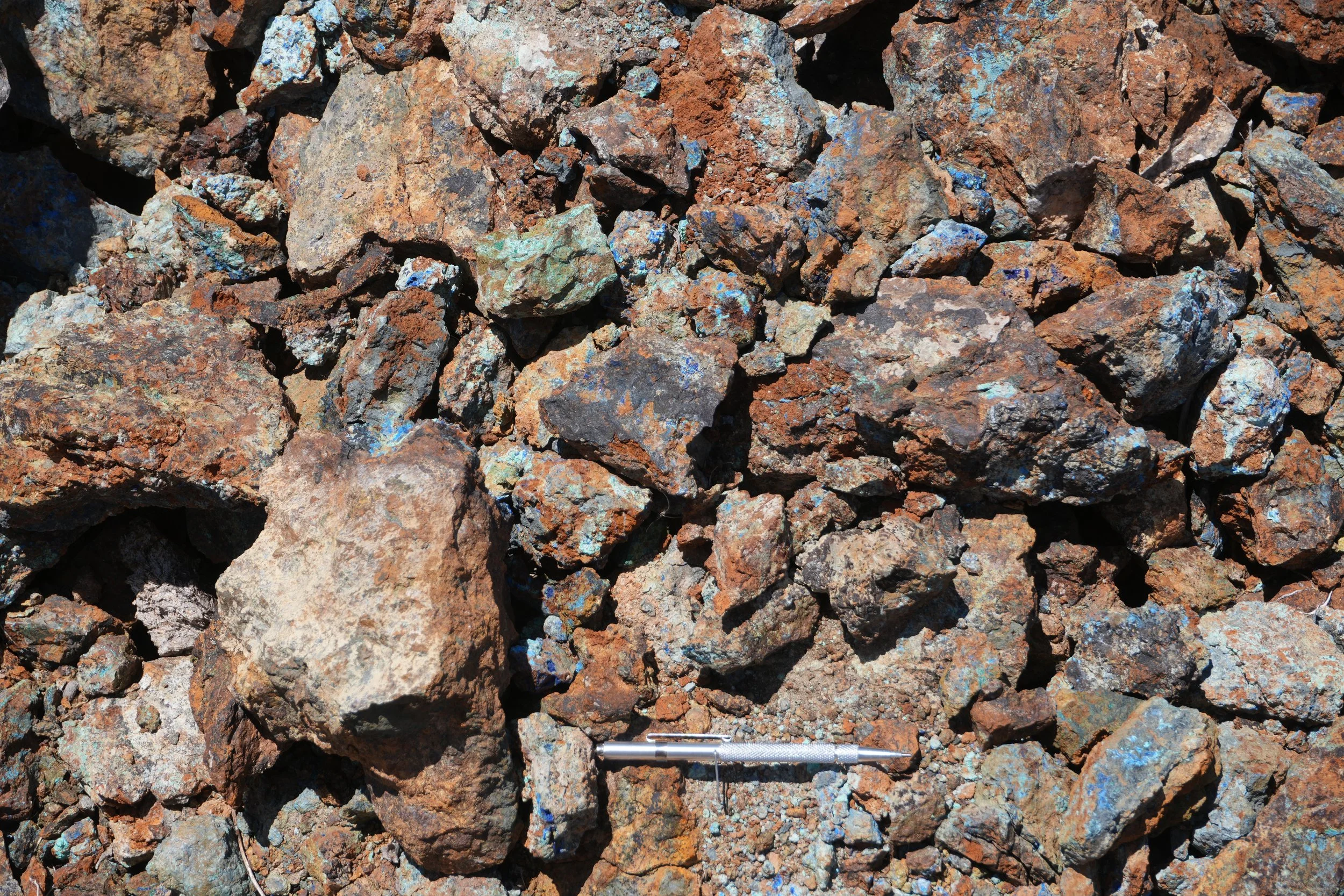
A detailed evaluation of historic waste dumps combined trenching, systematic sampling, granulometric analysis, topographic surveying, 3D modelling, and volumetric estimation. Ten pits (1–3 m deep) and 24 samples defined an estimated 8,120 tonnes of historic mine waste, with average grades of approximately 96 g/t Ag and 0.80% Cu, calculated using a loose bulk density of 1.43 g/cm³.
The waste material was screened using a 5 cm mesh to obtain samples suitable for manual sorting. Vein material (silica–carbonate) was separated from host rock (andesite), and each fraction was sent to the laboratory for analysis as separate samples. The vein material showed sulphide mineralization dominated by tennantite–tetrahedrite (locally freibergite), chalcocite–covellite, chalcopyrite, galena, and rare bornite. The veins include abundant barite and banded quartz, consistent with epithermal to mesothermal vein systems. 13.85 kg of vein material was assayed at AAA Laboratories and returned an average grade of 296 g/t Ag and 2.6% Cu.